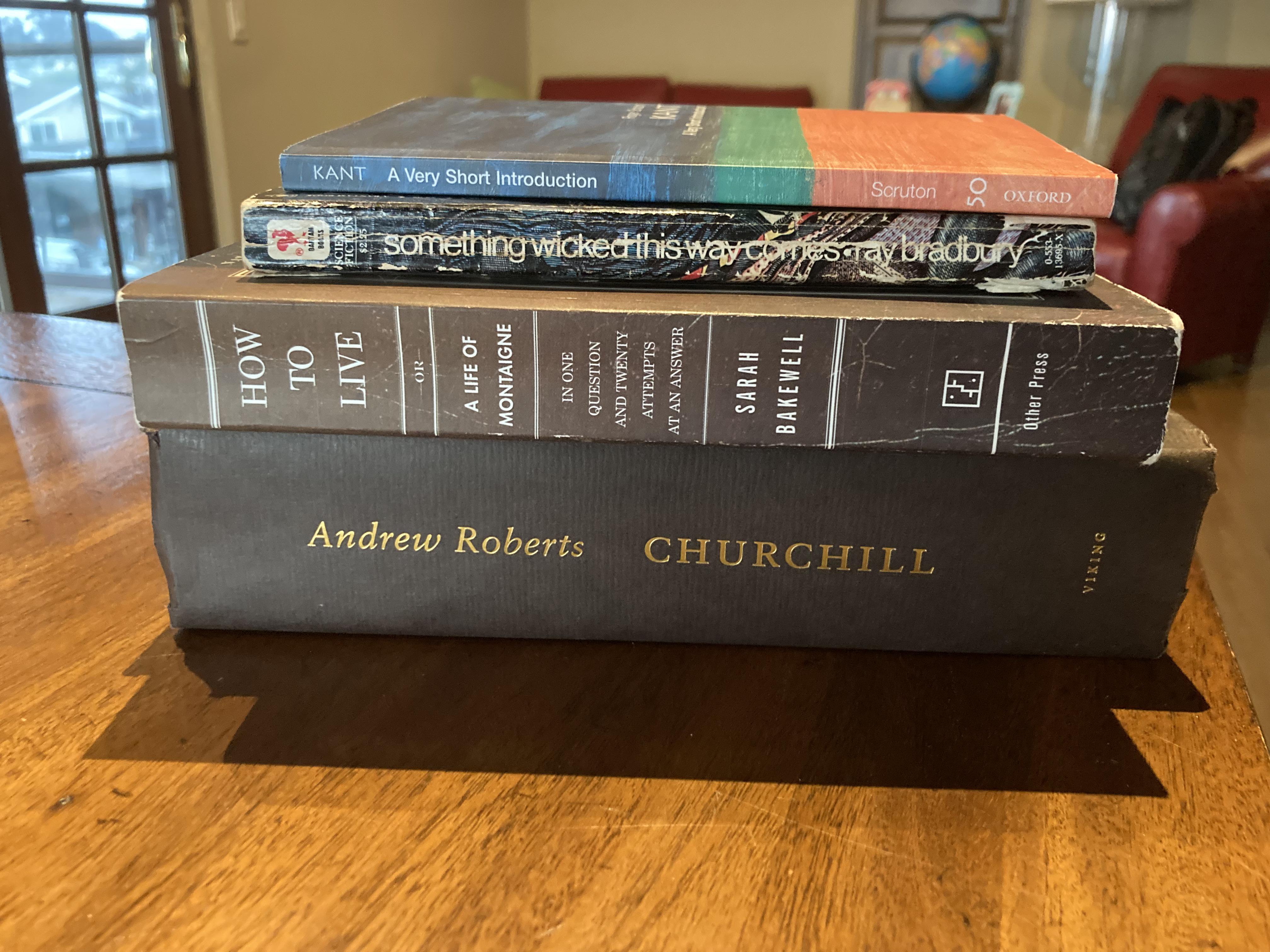
- How to Live or A life of Montaigne, by Sarah Bakewell. I bristled a bit at the title because how could Montaigne, or anybody really, prescribe how to live – as if they know. But I loved Bakewell’s At The Existential Café, so decided to give it a try and dive into Monsieur Montaigne. It is a great read. Bakewell deploys the same smart and breezy treatment of complex people and ideas, with a genuine enthusiasm for philosophy and its key figures. She just makes philosophy interesting and alive. And, man, was Montaigne alive – as a writer, politician, philosopher, farmer, husband, father and more. An inveterate reader, traveler, tinkerer – he loved the wild variety of life, and laughed (and cried) at the pride and foibles of humans trying to navigate our ‘three score and ten.’ Of course his loudest laughs were at himself. His ultimate answer for living a good life? Look to the Greeks and combine eudaimonia (living well, ethically flourishing) with ataraxia (living without anxiety) and you will sing a great song.
- Churchill, Walking with Destiny, by Andrew Roberts. My daughters’ get mad when they see yet another biography, of yet another man – certainly a fair criticism – but yikes, this dude was something else. An inspiring (and exhausting) life from so many angles. I can imagine the interviewer: What did you do with yourself Winston? Well, I saved the Western World. Literally. I wrote brilliant and popular works of literature – Nobel Prize winning literature – in my spare moments. Oh, I had a good, long marriage and a romping good time with a wildly diverse group of humans. Oh, I also painted – quite well and engagingly. I lived more in 90 years than most would in a thousand. All true, all true – and brilliantly covered in Roberts’ tome. I honestly enjoyed all 982 pages and found it incredibly instructive, even prescient, to see how much turmoil and risk the world faced during his time – political strife and global tension is not unique to our time. But I would also look up from the book and feel discouraged about our obvious lack of quality in current politics – I mean where are our Churchill’s today? Where are the thoughtful, literate, brave, energetic, committed women and men of today? Your gut tells you they are – the must be – out there, but where and whence?
- Something Wicked This Way Comes, by Ray Bradbury. A weirdly great book: with a sinister (and fantastical) storyline played out in a 1950s midwestern township – all ‘gee whiz’ and polite, but stormy, expectant, and unsettled; then suddenly confronted with a Stephen King-like carnival (think 2012’s Joyland) that alights the town one midnight and becomes Bradbury’s set-piece for musings on Time and Life. I kept turning the pages: what is this about? what is going to happen next? But it wasn’t just the narrative and characters that engaged me, kept me moving . . . no, the dominating feature of the story (which I read from a dog-eared paperback signed by the great man – my local bookstore seller not realizing he had a novel signed by the one and only Ray Bradbury) – is the absolute avalanche of words, metaphors and similes, adjectives and analogies, poetry and . . . on and on. Ray let the full arsenal of his linguistic talent run wild in this novel. He brought it all on, clearly at the height of his linguistic powers. Simply: his command of language is breathtaking. Yes, I enjoyed the wild, crazy story; but felt a bit awestruck (similar to reading Nabakov or Proust or Hugo as they bend and stretch and craft and revel in their command of language) at Bradbury’s (unexpected) talent and joy in just . . . writing.
- Kant, A Very Short Introduction, by Roger Scruton. This is a tight, engaging summary of the great philosopher’s philosophical influences and central works. Only 135 pages, it is rigorous, demanding, and focused– each sentence intentional, educational. Of course, synthesizing Kant is no small task, but Scruton does it remarkably well (aside: I remember my Rhetoric professor at Berkeley chiding us for getting only one semester of Kant: “Totally ridiculous, absurdly surface – you could spend your entire life reading Kant and still have more to assess.”), especially his treatment of Kant’s attempt to reconcile the two leading philosophies of his time: Rationalism and Empiricism. One tries to prove how human reason – alone and unaided – can understand the world as it really is (Leibniz); the other tries to prove that only human senses can tell us what the world is actually like (Hume). Kant works to reconcile the approaches into a grand unification of “transcendental idealism”, and Scruton does an admirable job telling the story. But it is Kant’s later work on aesthetics that drew my attention – I am a strong believer (strong feeler?) in the Logos (Greek), the Word (Christian), the Tao (Chinese) – basically, any philosophical construct that tries to capture the timeless Spirit we all feel, that we all intuit. It is so obviously there when we hear the wind amongst the pines at a High Sierra lake; or feel the love connecting and encompassing people at an intimate gathering of family or friends; or even strangers. There is clearly something “more”, something “before” everything that we can reason with our minds or feel with our senses. Kant called it the sublime and claimed it had transcendent origin. This feels right, and frankly I love it when the great physicists (e.g., Einstein), mathematicians (e.g, B. Russel) and philosophers – despite their voluminous and details attempts to describe and frame existence – ultimately hit a point of no return, a wall of awe and fall back on allusions to the Logos – to a time before time, an beginning with no beginning, a spirit that defies categorization, but may in fact be the most important force in all our lives.
– by MJB