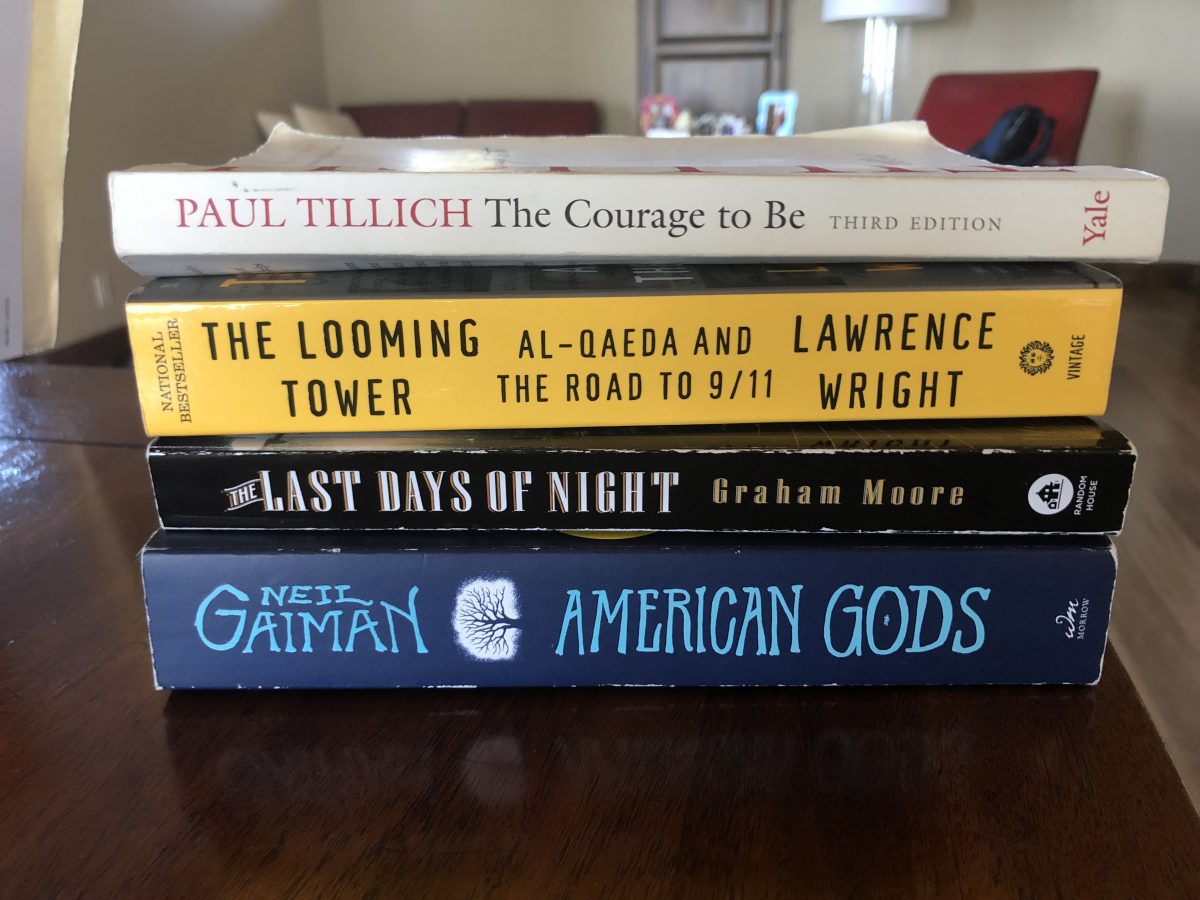
- The Courage to Be, by Paul Tillich. Canonical twentieth-century philosophy text that delves into the deep anxiety all of us have about “nonbeing” – losing ourselves and identity and place in this world. Just going away. And not only the anxiety about our existence and ultimate death, but the anxiety about having no connection or mission or substance. And so, we fight the anxiety with distraction (e.g., cable news pulling us in with constant and mostly meaningless ‘breaking’ stories), diversion (e.g., 50% of Americans engage in social networking at least once a day), drugs (e.g., 70% of Americans are on prescription medication; 80% drink alcohol). Tillich, although writing in the 1950s, is an extremely prescient thinker and would not be alarmed at the ‘frenetic surfaceness’ on display today — people clamoring for more hits and likes and followers, for more recognition, all under the assumption that ‘more’ will somehow prove or improve their worth and reaffirm their existence. But it is also a way of avoiding the deeper questions: why am I here and what is my purpose? Am I a good person? These are hard questions to answer and take time and thought. In Courage to Be, Tillich gives a roadmap for doing that, and although he is known as a Christian philosopher, he gives a nod to Existentialism. In particular, he accepts Sartre’s central tenant that “you are what you make of yourself”, but with a theological twist: he accepts that we make ourselves, but does not accept that our ‘making’ starts from an ?empty vessel’. Sartre would say you are literally an empty vessel; and your choices, made all the time, define who you are. Nothing else. But Tillich claims that the vessel has structure, has actually been constructed – set up – by none other than God. There is something there before we start to build; some scaffolding. In sum, this is a tough, but very rewarding read, with many insights to today’s cultural challenges.
- The Looming Tower, by Lawrence Wright. Like many Americans, most of my education about Islam, particularly radical Islam, comes from mainstream ‘news’ like the Wall Street Journal, New York Times, CNN or Hollywood — in other words, from surface, ‘bit-sized’ sources. The reality is most Westerners, including myself, didn’t know about radical Islam or think about its personalities and organization until after September 11, 2001. This Pulitzer-prize winning book does a great job of tracing the intellectual wellsprings of the movement — starting with the exacting and influential Islamist writer Sayyid Qutb and working through his fanatical and (ultimately) violent adherents Ayman Al-Zawahiri, Abdullah Azzam and Osama bin Laden. It then moves through the origin story of al-Qaida (including its merger with Zawahiri’s al-Jihad), focusing on the people — their upbringing, families, education, travels — and ultimate radicalization. Wright then takes the reader to the other side of the fence — the US intelligence community (F.B.I. and CIA) and its efforts to understand and defend against the impending threat — or, as bin Laden intoned in one of his recorded speeches: ” . . . wherever you are, death will find you, even in the looming tower.” The personalities here are just as compelling, particularly John O’Neill, the head of the FBI’s counterterrorism unit I-49. We watch him battle the almost willful ignorance of the CIA to the impending threat and see the mistakes that in hindsight we know have deadly consequence. A gripping and sobering story: gripping as it moves through the key events and people leading up to 9/11 so well; sobering as we see so much indiscriminate violence unleashed, so much death and the knowledge that we are perhaps no closer to understanding why or how or when it will stop.
- Last Days of Night, by Graham Moore. A fast-moving historical and intellectual romp, detailing the ?current wars? of the late nineteenth century — an intense battle over the invention of the incandescent light bulb — an invention that would change lives and lifestyles for forever — and the twin titans duking it out: Thomas Edison and George Westinghouse. Along the way we also get a fictionalized view into the true genius outpacing (at least intellectually) both men: Nikola Tesla. Edison battles Westinghouse; Westinghouse courts Tesla; Tesla get bored with both men, etc. Moore also does a good job showing how the battle was not too dissimilar to a modern high-tech battle we’re all familiar with: namely, the early battle over the personal computer with a hard-working engineer (Bill Gates, a.k.a. George Westinghouse) taking on a brilliant designer and marketer (Steve Jobs, a.k.a., Thomas Edison), with the real genius lurking in the background (a.k.a., Steve Wozniak). Like all major industrial shifts, it takes technical and business acumen, intense drive and hutzpah, and often a bevy of lawyers to pull it off. This book brings all those elements together, adds a dash of romance and keeps the reader turning pages.
- American Gods, by Neil Gaiman. I love odd, ‘spacey’ books, books that take you on a surrealistic ride — for example, anything by Paul Auster (especially his New York Trilogy) or Haruki Murakami (especially his Kafka on the Shore). This book takes a very unique premise — that there are forgotten Gods amongst us, Gods that need our attention and love to thrive; Gods that struggle to survive without it — and runs with it. Or rather drives it. We follow two major characters, and a slew of minor characters, on an epic road trip, traversing up and down and around the middle of American in search of answers and Gods and understanding. I had never read Gaiman, but upon the strong recommendation of a bespectacled Englishman in a small book store in Mammoth, California I bought it and initially enjoyed the romp at the beginning of the novel. However, about a third of the way into the book — nay, the ‘trip’ – I got bogged down in Gaiman’s incessant attempt to be interesting and unique (?I’m exploring a VERY unique premise here!?); he has you, then simply can’t put the pen down and keeps driving. Until your confused, tired and wondering what the trip was all about.
– by MJB