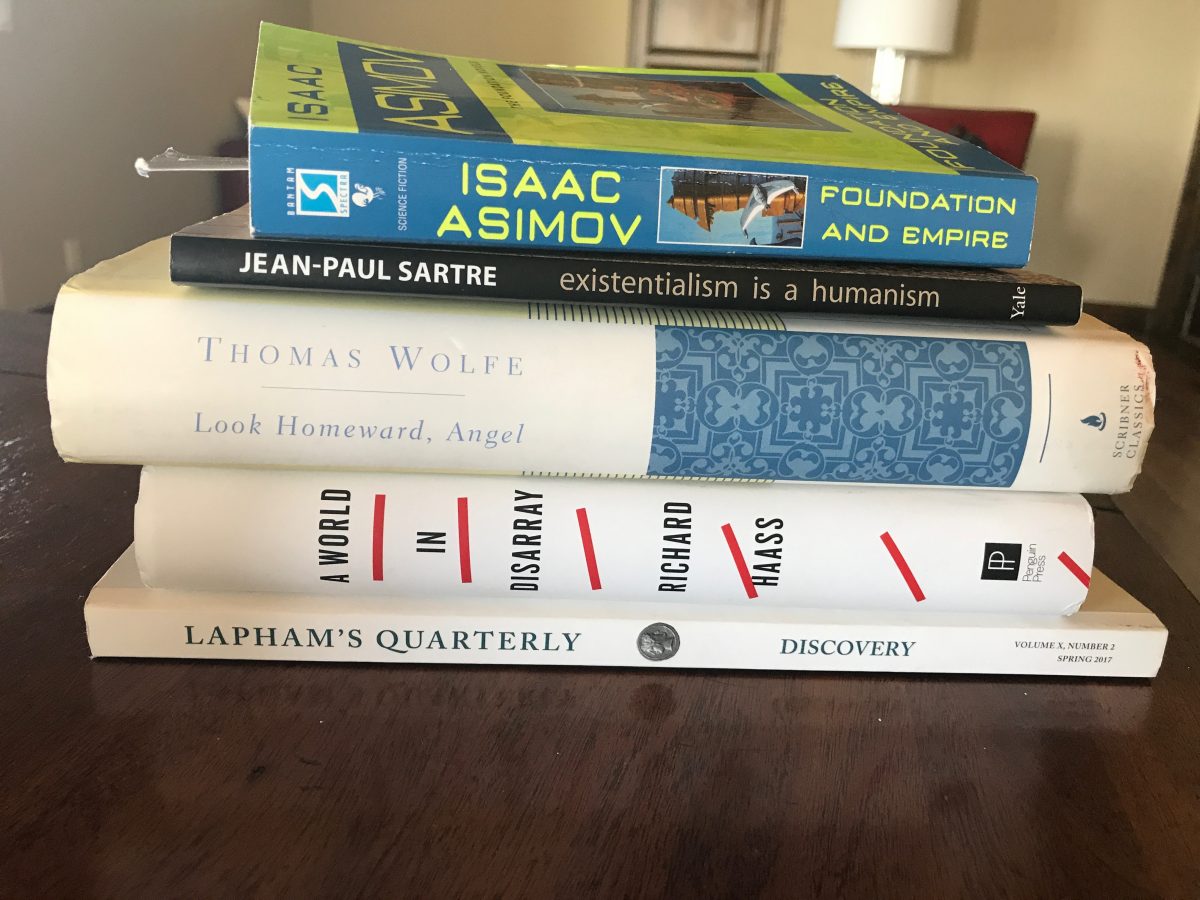
- Foundation and Empire, by Isaac Asimov. I read a lot of Asimov in high-school and college, including some of the Foundation novels, and recently grabbed this one, the 2nd in the classic series about a future “Star Wars”-type existence with the evil Empire groaning under its long dominance over the galaxies (a la Rome), and the upstart Foundation trying to wean humanity back to a more thoughtful and democratic place (a la an Athens). Like any great sci-fi writer, it is fun to see what predictions they got right, and what they got wrong – even somebody as prescient as Asimov is a creature of his world, a 1950s culture full of traditional social mores, but also visions of rockets and space and machines and wonder. And so sometimes he is right on (the descriptions of instant communications, and harnessing of light and energy) – and other times uncomfortably far off (the treatment of female characters as traditionally beholden to men). But, it is Asimov and it is the Foundation series and the plot moves quickly.
- Existentialism is a Humanism, by Jean-Paul Sartre. Simply one of the greatest philosophical treatise every put down on paper; in this case, the published text of Sartre’s 1945 speech at Club Maintenant in Paris. He was there to defend ‘existentialism’ as not something inhuman or uncaring, black and depressing; but rather, an essentially life-affirming, passionate and dynamic philosophy that put the control of life – our thoughts, our actions, our essence – in our own hands, not the hands of some distance diety or family structure or economic and political circumstance. And in the process he lays out the clearest and most powerful description of the philosophy and its foundation and purposes – a must read for anybody interested in 20th century philosophy and the endearing attraction of Sartre and existentalism.
- Look Homeward, Angel, by Thomas Wolfe. OK, I’ll admit: in all my literary travels, including my education in rhetoric and history at UC Berkeley, I never once – not once – ran across Wolfe. And it wasn’t until I recently saw the movie “Genius” on a long flight back from London (about his intense and fruitful relationship with the legendary editor Maxwell Perkins), that I dove into Look Homeward, his first novel. To say Wolfe is a great writer is totally absurd; he sits in the pantheon of true geniuses of the word – Dickens, Dostoevsky, Hemingway – and can produce sentences and insights that stun in their brilliance. It is like watching Roger Federer hit a no-look drop shot or ‘tweener’ down the line – it’s not only that he can do it, its how he did it – deliberately and beautifully. That is Thomas Wolfe, and that is this novel. It is not really the plot, essentially a coming of age story about the young Wolfe (disguised as Eugene Gant), but the writing and the insights, so profound for somebody so young, that keep you slowly, very slowly turning the pages. Awesome.
- A World in Disarray, by Richard Haass. I got a chance to listen to Haass at the Milken Institute’s Global Conference in Beverly Hills. Similar to Davos, the event brings together many of the worlds leading politicians, academics, intellectuals, business leaders, artists, etc. Haass, diplomat and long-time president of the Council on Foreign Relations, was there to quickly cover the geopolitical landscape and comment on many of the world’s most challenging issues. And he did so brilliantly, showing total command of the many issues we are all facing – Syria, North Korea, Brexit, Russia, China, etc. – and offering clear and confident opinions about where we are and what it all means. This experience motivated me to pick-up his most recent book and dive into his experience a bit more deeply. And, like him, the book is clear, insightful, worried, but not alarmist – good education for anybody trying to understand the context behind many of our global challenges. It allows you to get away from the shrill day-to-day of online news and twitter and stop, pause, think and predict. Should be required reading for many of our political leaders.
- Discovery, Lapham’s Quarterly, edited by Lewis Latham. Simply another brilliant collection of essays and letters, photos and historical anecdotes – this time on the constant lure of learning, or discovery. As Latham says in his opening essay: “Isn’t that kind of the fun, the looking into the vast darkness ripe with wonders that will never cease?”