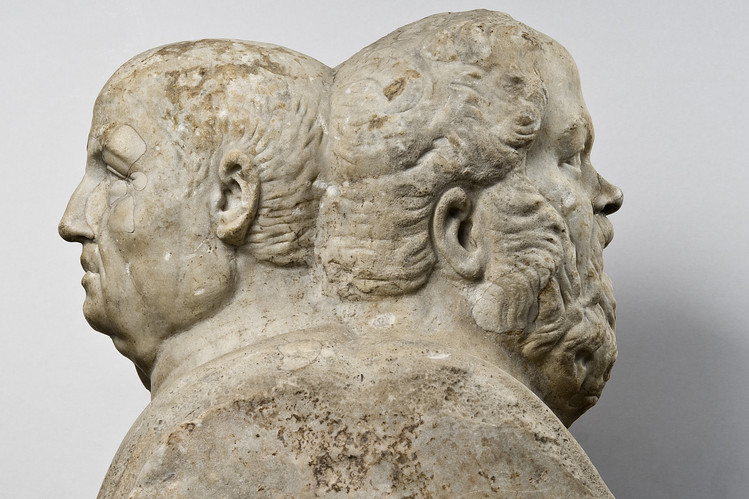
The unimaginable – certainly the unpredictable – continues, literally every day, in American politics. Strong feelings swirl across the political and cultural spectrum. Families, friends, co-workers, partners are embattled, angry, anxious; exhausted. I’m in the same boat, so felt it was a good opportunity to put Alain de Botton’s “Consolations of Philosophy” to work — namely, can the insights of great philosophers console during these tumultuous time?
Let’s start with Socrates, whom relies on logic as the elixir for all that ails us, and test his approach against our re-elected president. For example, he claims we are a great country, and then says he is going to stop immigration. The country is built on immigration and will continue to be built on immigration. B does not follow A. The president-elect also says he’ll rebuild American infrastructure while reducing taxes and debt. Spending more money while collecting less money does not result in a stronger balance sheet. Again, B does not follow A. And yet he holds both statements to be logically consistent and markets them as such. Illogic, at least for now, loudly prevails. And so we do not get much consolation from Socrates.
How about Epicurus? Friendship, freedom, pleasure and a thoughtful life are still available to us. The election did not stop my ability to befriend or love whomever I please, nor work and live where I choose. And certainly my thoughts are free to roam where – and as – they will. I like Epicurus because he urges us to focus on what is essential for a happy life — which is decidedly not more money, more things, more distractions and certainly not more bias and hate – but also find he hangs back, steps away from the stage (in his case establishing a commune outside Athens, with multiple partners, no children, no boss — i.e., not like anybody you or I know) and advocates a kind of intellectual farming life. Unfortunately, most of us are still in the mix, in the middle of the play and don’t have the luxury of passive resistance (and let’s be honest: many of us, like ambitious philosophers, enjoy being on the stage and are striving for a bigger part); and so, we’re agitated by the recent electoral plot twist and looking for realistic consolation – Epicurus doesn’t provide it.
So let’s leave the Golden Age of Greek philosophy and enter the first millennium, another time of extreme political tumult — namely, the insane leadership of Nero (who, among many things, murdered his mother, wife, half-brother and fed political foes to crocodiles and lions). Seneca, the Roman Stoic who tutored and served Nero for many years, only to be murdered by the tyrant at the age of 61, urges steely acceptance of the world, including its chaos, hostilities and violence. He asks us, as Botton nicely puts it to “. . . reconcile ourselves to the necessary imperfectability of existence.” In other words, we may wish to have a kinder, gentler election outcome and to forge ahead on a familiar path, but reality yanked us away from decades of liberal democratic policies, including a growing urban elitism and economic inequality, and towards a more isolationist, rural and jingoistic approach. Seneca would simply say: this was inevitable, Fortune’s prerogative, Deal with it. Moreover, he would emphasize that things change, carrying both positive and negative outcomes, and will certainly change again. To wit: “If you wish to put off all worry, assume that what you fear may happen is certainly going to happen”. This is tough, realistic advice, which allows us to shrug and soldier forth. But consoling? Not exactly.
OK, neither logic, nor stepping back, nor soldiering forth provide the consolation we seek. So, let’s move ahead 1,500 years and ask the inimitable Montaigne his take on the election. For starters, he would laugh: at him, at her (the hair, the pant suits, the tweets, the emails), at all of us. The foibles of human nature are of constant fascination to Montaigne, providing ample opportunities to laugh and cry at the same time. And while he would take the intense and widespread displays of elation, despair, conservative schadenfreude and liberal protest seriously, he would, like his future soul mate Mark Twain, wryly comment on the folly of human nature and the people that comprise it, including our new president-elect: “Upon the highest throne in the world, we are seated, still, upon our arses.” So, Montaigne brings much needed brevity to the equation and a reminder that we are really just animals rummaging blindly around the barn and to stop taking ourselves so seriously. And yet with a women’s right to choose in jeopardy, a minority’s right to vote increasingly restricted, and a world at religious and cultural war, humor doesn’t seem to win the philosophical day, nor provide substantial consolation. And ultimately, Montaigne’s approach feels like a cop-out – it’s easy to criticize and laugh; harder to engage and lead.
Time to move 180 degrees from detachment and humor, and into the starker nineteenth century worldview of Arthur Schopenhauer. Above all, he implores us to stop trying so damn hard to expect happiness: “There is only one inborn error, and that is the notion that we exist in order to be happy . . . So long as we persist in this inborn error . . . the world seems to us full of contradiction.” In other words, we all know the world is full of opportunities missed, actions regretted, desires unmet, compromises forced – and elections unimagined. So get used to it and be happy with your lot (or at least respect yourself, build friendship with your views, and stop looking for external validation). Because regardless of what happens and how bad things may seem, a primal Will-to-Life – the strongest force across all humankind – will overwhelm our irrational and destructive tendencies and move us forward. Life will trump death. So, even if Vladimir Putin takes advantage of an impulsive and chaotic leader and invades Europe, or Kim Jong-un stops testing nuclear bombs and starts using them, we will survive and our inborn Will will prevail. Of course this is hard to argue with – if an essential Will exists, and has always existed, then there is not much an individual can do that matters; a larger force is in control. Consoling in the abstract, but defeating in the concrete.
So far Socrates, Epicurus, Seneca, Montaigne, Schopenhauer – a decent swath of the western philosophical corpus – provide some consolation, but not enough for today’s post-electoral climate. I am still agitated; and I suspect many of you (if you’ve stuck with me this far) are still agitated. Luck is on the way when we reach my favorite – and most consoling – philosopher: the intense, energetic, contrarian and demanding Friedrich Nietzsche. He would ask us to embrace the recent electoral outcome and its concomitant anxieties, to look at this as a trial and celebrate how lucky we are to face it. And he would scoff at those crying from the sideline or shouting from the rooftops. Useless! This is a significant opportunity to strengthen our characters and political resolve, to get out of our liberal hovels and Do Something. Nietzsche is an active philosopher, and although he would share some of Seneca’s fatalism (bad stuff will happen), he would not be so accepting and passive. He wants us to do something, to work hard and reach the summit, no matter how difficult. In fact, the more difficult, the better. And in the process we will become more fit, expand our vistas and reach a better version of ourselves. In other words: the election of 2020 did happen, the Cheshire Cat won and not even Alice knows where this is going or how. So, we are forced to reassess our positions and culture, relook at our past and future. And in the process get a stronger, deeper sense of our lives. That I find consoling.
– by MJB