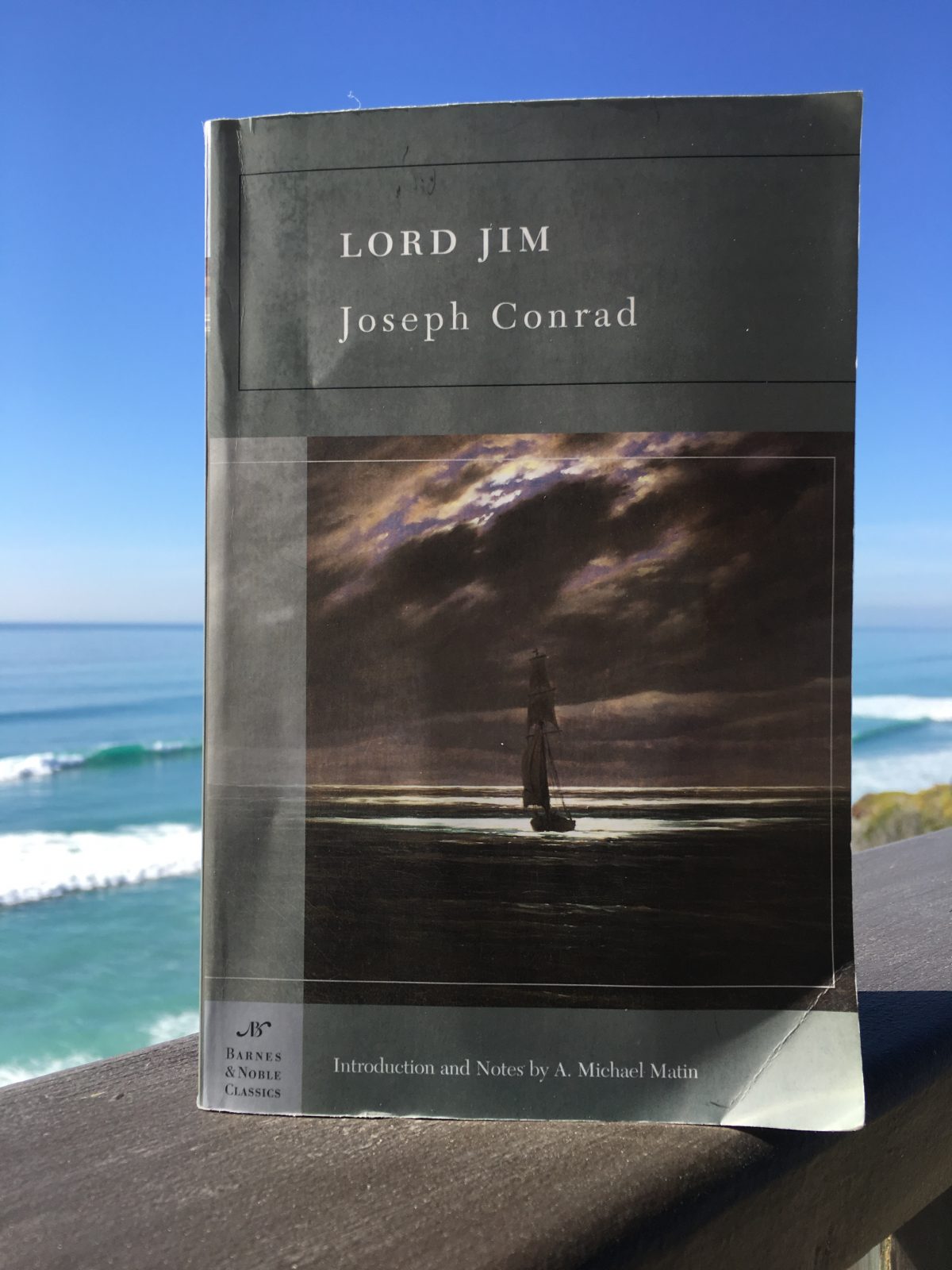
Two things stand out for me regarding Lord Jim.
First, the writing – sentence structure, syntax, dialogue – is extremely high quality. Like reading Dickens at his best – the text flows effortlessly, each word, each phrase perfectly selected and placed to accomplish its syntactical and narrative mission. Pages turn easily, leisurely, yet powerfully, like a mighty river building to its oceanic destiny.
And yet, that is not the point. This linguistic journey, this mastery of craft, is coming from an author writing in his third language. Not his first or second. His third. Joseph Conrad was a Pole, with Polish obviously his first language. Primarily home-schooled and beyond precocious, the young Joseph also mastered French (and a bit of Latin and Greek), the language of his favorite writers and poets (Flaubert, Maupassant, Hugo). But it is not until his twenties and thirties, after several years in the French and English merchant marines, that Joseph masters English – spectacularly. Writing from the quintessential English farm, he soon produces Heart of Darkness and Lord Jim – each a masterpiece of the English canon.
Second, reading this novel, as a man in midlife, is a struggle. The main character (or is he? to quote the narrator Charles Marlow, himself suspiciously indicative of the writer, “He existed for me, and after all it is only through me that he exists for you.”) is working to reconcile a stubborn youthful vision of himself with the reality of an incontrovertible and deplorable act – that he was a bald-faced coward in the heat of the moment. And yet the vision persists, as they do for all of us with ambition and feeling – those passionate and self-inspiring projections we hold about ourselves, identities that compel us forward into some great and misty future. But they, like so much about our youth, are really not there, more lost in a fugue of constant transformation.
More pointedly: As a man that has lived several decades on this planet, witnessing idealism crash headlong into reality on an daily basis, you want to tell Jim to just get over it and move on. “You jumped off the ship, the ship did not sink, you lived, they lived; time to move on.” But he does not, and Marlow, our narrator, does not. And perhaps that is the point of the novel: that those early perceptions of ourselves are so important, so strong, that we will literally go to the ends of the earth – in this case Patusan – to preserve them. We are obsessed with making the vision real; with objectively achieving the subjective goal. We are Ahab getting closer and closer to the whale . . . but alas, the beast is just – and always – out of our eternal grasp.
– by MJB